Showing posts with label national poetry month. Show all posts

Friday, April 15, 2016

Guest Post: Not a Poet

As a nod to April being National Poetry Month, I invited Michael Taeger to talk about his adventures as a prose writer reading (and writing) poetry. Enjoy!


While I’m not a poet, I am a writer. And as a writer, whenever I hear advice about writing that sounds plausible, even if it’s outside of my comfort zone or nominal area of interest, I pay attention. So when Andre Dubus III, author of The House of Sand and Fog, gave a reading and Q&A in the summer of ‘14, I listened to what he had to say, hoping for insight. After his good-not-great reading, someone in the crowd asked him what he read. Normally a boring question with boring answers, he said, “Every night before I go to sleep, I read from a book of poetry.”

Well, I thought. That’s unexpected.

He went on to explain that while he isn’t a poet, he reads poetry because it engages dormany areas of his brain; that poets string words and phrases together in ways that make him pause and think about the universe; that his creativity, sparked by poetry, continues into his prose-writing. While he never neglects his other reading, poetry is his reset button.

A couple months later, Abigail Thomas (author of Safekeeping) gave a lecture and reading that I attended. again, an audience member asked for her reading habits. She said, “I always keep poetry on my nightstand.” She went on to echo many of Dubus’ words, about creativity and imagery and soft reset.

When Pulitzer-Prize winning novelist Michael Chabon gave a lecture to my MFA program in early 2015, I raised my own hand. “I’ve been hearing that a lot of prose writers read poetry regularly. Do you keep that practice?”

I probably don’t have to write down his answer. He reads poems for the same reasons that Dubus and Thomas do; because poetry operates on a different level than prose. It is sentence-level writing, devoted to nothing but imagery, ideas and sounds. Reading good poetry is weight-lifting for the brain.

Maybe I should give it a try.

Since then, I’ve made a conscious effort to read more poetry: 10 (or so) complete books since April. It’s been a success, one that’s made me excited to continue. Traci Brimhall’s book of post-apocalyptic poetry, Our Lady of the Water, made me second-guess what poetry can do and and former Poet Laureate Ted Kooser’s Splitting an Order, made me cry through painfully honest, deceptively simple language. I can’t remember the last time a book evoked tears or reconstructed my entire perception.

In addition, I discovered that apart from personal gleanings, poetry affected my writing as well. Now, I’m not suddenly an entirely different writer, but I pay more attention to imagery and structure than I ever did before. I am more attuned to, and value more, interesting phrasing and unusual metaphors.

It’s obvious that other authors do the same. Go back and read All the Pretty Horses by Cormac McCarthy or One Hundred Years of Solitude by Marquez. The cadences and sentence structure of those brilliant novels is poetry. The prose lilts and elevates and turns around and around, forcing the reader to keep up with the journey. Besides telling a story, those novels are devoted to and in love with words.

On my nightstand right now are half a dozen books of poetry, carefully interspersed with works of prose. I’m currently reading Scarecrone by Melissa Broder, Anna Slesinski’s book of erasure poems Eating the Sun, and Bruce Wayne Sullivan’s bartender poems, Reflections from the Other Side, along with my normal fare of classic literature, graphic novels and sci fi/fantasy. And I have a stack of others up to my knees that just hasn’t made it to the table yet.

I’m still not a poet, but I’m more complete as a writer. And maybe I’ll be a poet someday. It’s always possible. 

Michael B. Tager is a writer. He is the author of the fiction collection "Always Tomorrow" and "Pop Culture Poems," a poetry chapbook (Mason Jar Press). He is currently writing a book of memoir told through essays about video games. He likes Buffy and the Baltimore Orioles. Find more of his work online at michaelbtager.com.

(Also, if you are interested in having Michael guest post for your own blog, connect with him on twitter @ideosinkrasee)


Monday, April 28, 2014

"Hypothesis," A Sonnet by Me!

Because we just talked about sonnets last Thursday, I thought I'd share with you a Shakespearean sonnet I wrote last year for an English class. And it's a perfect time to share it for a different reason as well. It's the perfect representation of how I'm feeling right now - it's almost finals season!

"Hypothesis"
How pleasant it would be if time stood still,
Just so I could complete my to-do list.
If only I could stop time at my will,
The deadlines would not be so often miss'd.
I would have all the time that I desir'd
To study for my college Physics test -
And with that extra time, I'd be inspir'd
To write my English essay with more zest.
To parties I'd be able more to go,
(Since with my schoolwork quickly I'd be through)
And listen longer to the radio,
And read the thousand books that I want to.
      In truth, hypothesis is all this is,
      So now I must go study for my quiz.

Yep - off I go to study some AP Psychology!

~Sophia

Post Script: Because of this school craziness, sadly I won't be posting Top Ten Tuesdays for the next two weeks. :-(

Thursday, April 24, 2014

National Poetry Month: Sonnets!

April is National Poetry Month!
And right now, we're focusing on Sonnets - woot!

Sonnets are super easy to write. You have a structure, you have a meter, you just need to find words that fit it all. :-)
(Well, maybe not so easy. But for me it's easier than writing free verse, and my sister - who is more of a poet than I - agrees. If you want to write poems, but don't know where to start - start with limericks, and then move on to sonnets. The structure definitely helps.)

I'm going to talk about three types of sonnets - Shakespearean, Italian, and Spenserian. There are others, but these are the main ones. But first, we need to start with a description of meter - specifically iambic pentameter. (If you know what this is, feel free to skip.)

Meter refers to the rhythm our words make when we speak. When the rhythm is da-DA da-DA da-DA, it's in iambs (each da-DA is called an iamb). For example, "ToDAY I ATE some BREAD with JAM." We usually talk in iambs. Take a random sentence, and see if it's in iambs. Most likely, it is.

"Hey! Did you buy some fruit?"
"I did not have a chance to."
"There was a sale today!"

That's all in iambs. Of course, we don't say "Hey! DID you BUY some fruit?" :-)

There are other kinds of feet (iambs are a type of feet). For example, there are trochees (DA-da DA-da DA-da). We sometimes speak in these, too. Then there's dactyls (DA-da-da DA-da-da DA-da-da). And anapests (da-da-DA da-da-DA). And a lot of others. But sonnets are usually (always?) written in iambs.

But I said they were written in iambic pentameter! What does that mean? It just means that for every line in a sonnet, there are five (pent-) iambs. (It can be tetrameter [three], quatrameter [four], even monometer [one iamb per line]. You can go as high as you like - heptameter [seven], octameter [eight], etc.) So a basic sonnet goes something like this:

da-DA da-DA da-DA da-DA da-DA
...and so on and so forth...

Now that we understand iambic pentameter, let's move on to actual sonnets!

Sonnets usually deal with some conflict, and are divided into a part setting forth the conflict, and a part resolving the conflict in some way. Also, sonnets tend to be consistently 14 lines long. See what I meant about the strict structure?
Now, let's discuss...

Shakespearean (or English) Sonnets!

Obviously, the guy who wrote these a lot was none other than:
William Shakespeare himself!
He wrote 154 sonnets. Yup.
So, the Shakespearean sonnet is of the form ABAB CDCD EFEF GG, where each letter signifies a new line, and the lines with the same letter rhyme. Remember, every line is in iambic pentameter. Also, in a Shakespearean sonnet, the conflict generally makes up the first 12 lines (or three quatrains), and is quickly resolved in the last two (the final couplet, which is generally indented, to show its difference from the rest of the poem).

Here's an example of one of Will's sonnets. Do you "feel" the iambic pentameter?
Sonnet 73 
That time of year thou may'st in me behold  
When yellow leaves, or none, or few, do hang
Upon those boughs which shake against the cold, 
Bare ruin'd choirs, where late the sweet birds sang. 
In me thou see'st the twilight of such day, 
As after sunset fadeth in the west, 
Which by-and-by black night doth take away,
Death's second self, that seals up all in rest. 
In me thou see'st the glowing of such fire 
That on the ashes of his youth doth lie, 
As the death-bed whereon it must expire 
Consum'd with that which it was nourish'd by.    
      This thou perceiv'st, which makes thy love more strong, 
     To love that well which thou must leave ere long.
You can probably see the conflict is about death and the fleetingness of life, and then the resolution is that it is this fleetingness that makes him love her so much more.

 Next up...

Italian Sonnets!

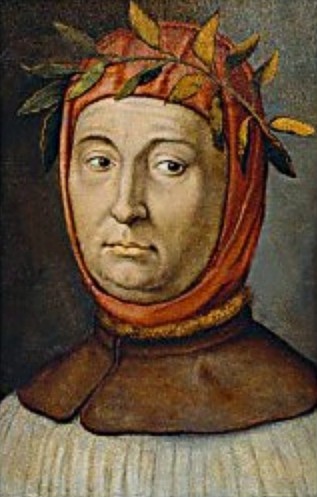
These are also sometimes called Petrarchian - after this guy:
Petrarch, an Italian scholar and poet

These are of the structure ABBA ABBA CDECDE. Well, the last sextet (or six lines) can sometimes have a different rhyme scheme, such as CDCDCD, or even CDECED. This one gives you some flexibility.
Here, generally the first two quatrains (the first eight lines) present the conflict, and the final sextet presents the resolution, though with this also there is flexibility.
Here's an example by Wordsworth:
"Scorn Not the Sonnet"
Scorn not the Sonnet; Critic, you have frowned,
Mindless of its just honours; with this key
Shakespeare unlocked his heart; the melody
Of this small lute gave ease to Petrarch's wound;
A thousand times this pipe did Tasso sound;
With it Camoens soothed an exile's grief;
The Sonnet glittered a gay myrtle leaf
Amid the cypress wtih which Dante crowned
His visionary brow: a glow-worm lamp,
It cheered mild Spenser, called from Faery-land
To struggle through dark ways; and when a damp
Fell round the path of Milton, in his hand
The Thing became a trumpet; whence he blew
Soul-animating strains--alas, too few!

And finally:

Spenserian Sonnets!

These were named after Edmund Spenser, who you may know as the author of the epic poem The Faerie Queen: 
Spenser
The Spenserian sonnet is basically a modification of the Shakespearean sonnet, where you use the last line of the previous quatrain to determine the rhyme scheme of the next one. Here's the structure:
ABAB BCBC CDCD EE. See how the rhyming sort of overlaps?

Here's an example:


"One day I wrote her name upon the strand" 
One day I wrote her name upon the strand,
But came the waves and washed it away:
Again I wrote it with a second hand,
But came the tide, and made my pains his prey.
Vain man, said she, that dost in vain assay
A mortal thing so to immortalize!
For I myself shall like to this decay,
And eek my name be wiped out likewise.
Not so (quoth I), let baser things devise
To die in dust, but you shall live by fame:
My verse your virtues rare shall eternize,
And in the heavens write your glorious name;
      Where, whenas death shall all the world subdue,
      Our love shall live, and later life renew.
Here, I believe that the conflict is resolved in the 9th line. So it seems that there is flexibility with conflict/resolution structure here as well. 

And those are the basic forms of sonnets.
I strongly suggest you try one - especially the Shakespearean kind. They aren't too hard. But a rhyming dictionary like this one might be useful; English isn't a very rhyme-friendly language.

Later on, I might post some of my sister's excellent sonnets. And maybe one of mine as well :-)

I talked more about writing sonnets than actually reading them, but understanding meter and the whole conflict/resolution business can make reading sonnets a bit easier.

~Sophia
____________________________________________________________
Since it is National Poetry Month, I thought I'd start a collective poetry effort. Make your contribution HERE! All you need is a pinch of creativity to write a line or two. 

Monday, April 7, 2014

It's National Poetry Month!

Hey everyone! Did you know that April was National Poetry Month?
Here's a summary of what it is (thanks to poets.com):
Inaugurated by the Academy of American Poets in 1996, National Poetry Month is now held every April, when schools, publishers, libraries, booksellers, and poets throughout the United States band together to celebrate poetry and its vital place in American culture. Thousands of organizations participate through readings, festivals, books displays, workshops, and other events.
 So what am I going to to do for National Poetry Month? Well, I'm not as big a reader of poetry as I am a reader of fiction, so I'm going to use this month to explore poetry in more depth than I usually do. Here's a smattering of what you can look forward to in the next couple weeks.
  • Sonnets! Shakespearean, Italian, and Spenserian
  • Nonsense poetry - because it's awesome. 
  • And much more that I will think up over the course of the month!
ALSO, I am starting a cumulative poem HERE. Go ahead and contribute a line - I'll post the complete poem on May 1st!

Some questions for you:
Who's your favorite poet?
What's your favorite type/era/style of poetry?

Let me know in the comments!

~Sophia