Wednesday, May 14, 2014

Ender's Game by Orson Scott Card // Nullo Is Awesome!

Boy, it felt good to breeze through a book. I'm getting tired of month-long projects.
I read Ender's Game in a weekend. You know what that means?
It means the approach of freedom.
It means Summer is coming.
The amount of time it takes for me to read a book is directly proportional to the amount of homework I have. Homework is lessening. I have more time for reading.
Yippee!!

Anyway, let's talk about Ender's Game.
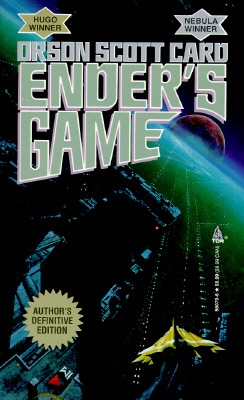

Ender's Game is set in an alternate version of our world. We have expanded into the universe and are fighting with aliens that we call "buggers." We've already had two major Invasions, and we are preparing for the Third Invasion. 
Ender is a six year old boy genius (SIX. I love it. But we'll talk characters later.), who is chosen to save our world from the buggers. He is taken from his family - from his dearly beloved sister - to be trained in semi-isolation in the space-station Battle School, where future space soldiers learn tactics and fighting. 

Let's digress a bit and talk about the lessons. They train in zero-gravity ("nullo," they call it), which I would LOVE to try. I love this idea of zero-gravity so much that I had a dream about it and was trying to employ the techniques that Ender was using in the book. WAT.

Now then:

What I Loved

(The whole concept of nullo, obviously. But besides that.)

The fact that Ender is SIX. He has the brain of someone much older, but still, he is SIX (in the beginning, at least). A character so young is so unconventional, and I love it. For most of the book, he is not even a tween. It's great. It also makes it hard to picture him as a little kid, because his vocabulary and his mental processes are just so above that age, and I had to keep reminding myself as I read.

I also loved the detail about the technology and the techniques that Ender and his fellow students learned. Hey, it allowed me to dream about it better! :-)

I felt so bad for Ender throughout the whole book. I wanted to give him a hug, say, "Don't worry, you can cry on my shoulder, I'm not trying to use you, I just want you to be happy!" And then when I read this...

"We have to go. I'm almost happy here... I've lived too long with pain. I won't know who I am without it."
...my heart broke for him.

Ender had never known a life of happiness, a life where there wasn't someone, somewhere, who was in control of him. 

Oooh ooh let's talk about the ending! 
Man, was that a superb twist! It just jumped on me out of nowhere (the same way it did on Ender, except I wasn't QUITE as emotionally involved), and gave me tingles, the way good twist endings do. And the final chapter tied it up neatly, in an epilogue sort of way, where it didn't feel rushed but dealt with practically every loose end. 

One confusion I had with the ending, but it involves a spoiler, so... (Highlight to reveal spoilers)

Did the other kids - Petra, Alai, Bean, etc - know that it wasn't a game? Did they also think that they were just piloting little dots of light on a screen? Wouldn't they be just as freaked as Ender? And if they DID know - wait, is that even LEGAL? I don't get it. Don't they deserve just as much pity as Ender? They were fighting real things too. They were killing and destroying real beings too. They probably will have a decent amount of PTSD. Darnded I.F.. I hate them, ruining little kids like that. Yeah, yeah, I know they saved the world. STILL.

If you can please clear up this confustion, I'd appreciate it. Just give good spoiler warnings in the comments so no one else gets spoiled. :-)


What I Didn't Love So Much

The one thing I didn't exactly like was that Card's writing occasionally slips into telling, instead of showing. In fact, this happens more than occasionally. It makes some sense, since the book spans a good number of years, but still, it can dull the reading.

Ender's Game was a fun book. It was clever, it was funny, it was engaging, and it was deep. It dealt with intense issues in a non-intense way. It surprised me with it's plot and with its characters.

Now to read the rest of the series... I've heard different things about which books to read next - Ender's Shadow? Ender in Exile? Or a different one? What do you think? Which order do YOU think is the best?

~Sophia


Tuesday, May 13, 2014

Top Ten Tuesday: Books I ALMOST Put Down


As always, hosted by The Broke and the Bookish.
Today's topic is Books I Almost Put Down - But Didn't.
I'm going to take that to mean - books I sloughed through.

1. Moby Dick by Herman Melville.
This book was rather boring. WAY too many nonfictional digressions on the history of whaling and the anatomy of a whale and the symbolism of whales etc.

2. War and Peace by Leo Tolstoy.
Here, there were a LOT of philosophical digressions - but that's just par for the course with Russian literature. However, I do not regret finishing this book. It was NOT a waste of time, and was a fantastic experience. And now I can say I read War and Peace cover to cover! (And wrote a pretty nice essay on it, too!)

3. Bel Ami by Guy de Maupassant.
I know I ranted about this one before. I love Guy de Maupassant - he has an excellent way with words - but Bel Ami was just so unsatisfying for me. The reason I didn't put it down was because I had hope that he would end it well. He didn't.
(Oh, and I found the post where I ranted about it, by the way.)

4. Les Miserables by Victor Hugo.
I bet you didn't think you'd see this guy on this list, did you? I've sung my praises of Les Miz on here more than once, but that was after I'd read it for the second time.
See, the first time I read it, I was - twelve? thirteen? - and I did enjoy it. But there were far too many digressions for me to not have doubts, and I did consider putting it down. THANK GOD I DIDN'T. The second time I read it, I was ready for the digressions, and took them as they came. Some I read. Some I didn't. But I relished the story more because I wasn't freaking out about missing something just because I skipped some random section on the history and philosophy of slang.

Well, only four today, I guess. This one was a bit difficult for me. I guess I rarely finish books that I am considering putting down.

What about you? What books have you almost put down - but didn't?

Monday, May 12, 2014

Spin Results


So the results of the Classics Club spin have been revealed! The book I will be reading is...

(...drumroll please...)


This is going to be a reread for me, since I read this book back when I was ten years old. I was reading The Count of Monte Cristo at the time, but my friend insisted that I read Gone with the Wind next. Considering that Count is a rather long book, she was insisting for a rather long time - but I eventually read it. And loved it! 

But I haven't read it in a good many years so I'm looking forward to revisiting it. It's a little longer than I was hoping for, since I'm leaving for Italy in a week and would rather not lug a tome that heavy in my suitcase. Oh well. (More about Italy later this week.)

If you're doing the spin, what book did you get?

And if you've ever been to Rome (or Venice or Florence), got any recommendations on experiences I absolutely shouldn't miss? :-)

~Sophia

Sunday, May 11, 2014

The Bible Project: Week 18 and 19 (1 Chronicles)


Hey, look at that! I'm back on track with my reading schedule!

1 Chronicles can be split into two parts:

Ch. 1-9: NAMES and MORE NAMES. The Chronicler really liked genealogy, and seemed to have a thing for identifying every single person involved in every single battle and great event. Every single person and their children, too.

Ch. 10-23: Retelling of David's story from back in 2 Samuel.

So really, nothing new. I'm sure if I read super carefully, I could write a discussion on the differences between the Chronicler and the writer of 2 Samuel, but I don't have time for such super in-depth analysis right now.
One difference that an annotation in my Bible pointed out to me was a wording change in 1 Chron 21:1. ("A satan rose up against Israel, and he enticed David into taking a census of Israel." - A census was sinful because the idea was that the people belonged to the Lord, not to the king, and thus only the Lord should know their exact number.) Here's what the annotation has to say about it:
In the parallel passage of 2 Sam 24:1, A satan is instead the Lord's anger. The change in the term reflects the changed theological outlook of postexilic Israel, when evil could no longer be attributed directly to God.... Here, as in later Judaism and in the New Testament, satan, or the "devil," designates an evil spirit who tempts men to wrongdoing.
So here we have the first mention of the Devil, which I thought was pretty cool.

That's all for today - the spin book is revealed tomorrow!

~Sophia


Monday, May 5, 2014

The Bible Project: Week 17 (2 Kings)


I know I've been somewhat AWOL in the blogosphere for the last week or so, but I do have excuses. These next two weeks are incredibly full of finals and I have been studying for them like crazy.

Anyway, on to 2 Kings. (It's actually week 18, but I promise I'll catch up soon...)

1 Kings and 2 Kings have a very similar style, which would make sense considering that they were originally part of the same book. So in 2 Kings we have more summaries of the lives of various rulers with confusing names. Some of them are loyal to God, but many do not follow God's laws.  They make temples to other gods on high places, and even when there is that one rare king that destroys all the pagan temples, it's still isn't enough for God to for completely forgive his people. 

I don't really have that much to say about this book. I read that Chronicles is actually an expansion of the Books of Kings, so I'm not sure if I'm looking forward to that or not. We shall see. I'm not really that big on history. 

~Sophia


Post Script: I know my plans for National Poetry Month didn't exactly work out, but April was just so busy. The cumulative poem sort of failed but it was a rather spontaneous idea so I wasn't expecting that much out of it. All we have are three lines, which are as follows:

The light of the lantern slowly shifts to eerie blue - but no one sees.
A Mighty Metamorphosis that raged across the labile land, 

        Grew stronger as the cobblestone was turned to sacred silver sand.

Deep, huh? :-) 


Classics Club Spin #6

So instead of doing a Top Ten Tuesday, I'm going to post my options for the Classics Club Spin #6.

For those of you who don't know, here are the rules of the Spin:

1. I pick out 20 books from my Classics Club list and number them 1-20
2. The Classics Club announces a number on Monday, May 12th.
3. I read the book that I assigned to that number by July 7th!

I think I'm going to be lazy and grab my list from the last spin. I just will replace a couple books.

So here's the list:

Rereads:

1. Gone With The Wind by Margaret Mitchell
2. Wuthering Heights by Emily Bronte.
3. Joan of Arc by Mark Twain
4. A Tree Grows in Brooklyn by Betty Smith
5. The Scarlet Pimpernel by Emmuska Orczy

I Can't Wait to Read:
6. O Pioneers! by Willa Cather 
7. 1984 by George Orwell
8. To Kill a Mockingbird by Harper Lee
9. Cyrano de Bergerac by Edmond Rostand
10. The Sea Wolf by Jack London

I'm Dreading:
11. Ben Hur by Lew Wallace (I started this one a few years back and only got a few chapters in.)
12. The White Company by A. Conan Doyle (Can you believe I've started this onetwice and haven't finished it yet?)
13. Don Quixote by Miguel de Cervantes (Well, this is both dreaded and anticipated. I'm both excited yet a little intimidated by the size...)
14. The Grapes of Wrath by John Steinbeck
15. Catch-22 by Joseph Heller

I'm Neutral About:

16. The Diary of Anne Frank by Anne Frank
17. The Hunchback of Notre Dame by Victor Hugo
18. The Man Who would be King by Rudyard Kipling
19. An Ideal Husband by Oscar Wilde
20. The Making of a Marchioness by Frances Hodgson Burnett

Friday, May 2, 2014

Gawain and the Green Knight

I read this translation by Brian Stone
Gawain and The Green Knight was written by an unknown poet people call the Pearl Poet, since he also wrote the poem Pearl. There are numerous translations from the old English of Gawain, including one by Tolkien, which I didn't read unfortunately. (I have read Tolkien's translation of Pearl, though!)

I finished Gawain a while ago, but I didn't write my essay for the Arthurian Lit course until recently, so here it is: the idea of Parallellism in Gawain and how it binds the story together.


Throughout Gawain and the Green Knight, the Pearl Poet incorporates many examples of parallelism. This provides an insight into the deeper meanings of the story, and also helps the reader make connections as they progress through the book. These parallels, through similarities as well as through contrasts, help in the interpretation of the book, and ultimately reveal what the Pearl Poet is trying to say about the search for truth and virtue.
The most obvious example of parallelism in Gawain and the Green Knight is a comparison between Gawain’s actions for three days with his host’s wife, and the three blows that the Green Knight gives him at the climax of the story. As Gawain gave in and took the green sash from the lady, so he again gives in to his fear and flinches before the Green Knight’s first blow. The second blow stops short, paralleling Gawain’s resistance to anything else but kisses from the knight’s wife. And the third blow leaves him with a small scar on his neck, to constantly remind him of his deception towards his host.
Another example of parallelism can be seen between the three animals Sir Bertilak kills on his hunts, and the three temptations given by the host’s wife. The first animal, the fox, is a symbol of deceit, pretending to be dead in order to trap his prey. The second animal, the deer, symbolizes the flesh and carnal desires. And the boar, the third animal, is a symbol of worldly treachery. The Pearl Poet uses this parallel, and characterizes the hostess as representing the flesh, deceit, worldliness.
Medieval artwork depicting the Green Knight
Parallels can also be found between the covenants in each of the fits. The covenant made in Arthur’s court between Sir Gawain and the Green Knight is closely interwoven with Gawain’s temptations in the Green Knight’s castle, and a strong sense of right in truth and fair exchange emerges from the beheading in Arthur’s court, the temptations by the hostess, and the final encounter between the Green Knight and Gawain.
                The Pearl Poet also provides parallels through contrast, such as between the lively hunt and the quiet bedchamber, as well as between Gawain’s harsh, cold journey and Sir Bertilak’s warm castle. The most obvious example of contrast is between Sir Bertilak’s beautiful young wife and her old, ugly lady in waiting, who is actually Morgan le Fay in disguise. The contrast between the noble Gawain and the Green Knight is also striking, as the Green Knight is described as lacking chivalry.
                Yet another example of parallelism through contrast can be seen in the two different roles the Green Knight takes on through the story. In the beginning, he is harsh, evil, and unchivalrous, clearly coming from some supernatural source. But eventually, he takes on the role of Gawain’s confessor, who teaches Gawain a lesson and helps him see his faults.
                The ultimate contrast is between Gawain’s pentangle symbol in the opening of his journey, and his green baldric in the end. At the outset, the pentangle – the symbol of the valiant, truthful knight – showed the world that Gawain was a perfect knight, and he himself only saw his faith in the Virgin Mary. By the end, however, the world now sees his shame in the baldric, the green belt he sinfully accepted from the Green Knight’s wife. Though they see his sinfulness, the rest of Arthur’s knights forgive him his fault and wear green sashes as well.

                The story ends with the motto “Hony soyt qui mal y pense” – “Evil to him who evil thinks.” This emphasizes the Pearl Poet’s theme of truth and virtue, for, as Gawain says, “Man can conceal sin, but not dissever for it” (p. 114). Ultimately, Gawain and the Green Knight is a moral tale, using parallelism and contrast to reveal its lesson: no human is perfect, but, despite our flaws, we should all should strive to achieve truth.
Art by John Howe for the Tolkien translation


~Sophia